
Katja Krause · 8 October 2026
Adapting Workflow Automation Features to Handle Regulatory Shifts in Distributed Systems
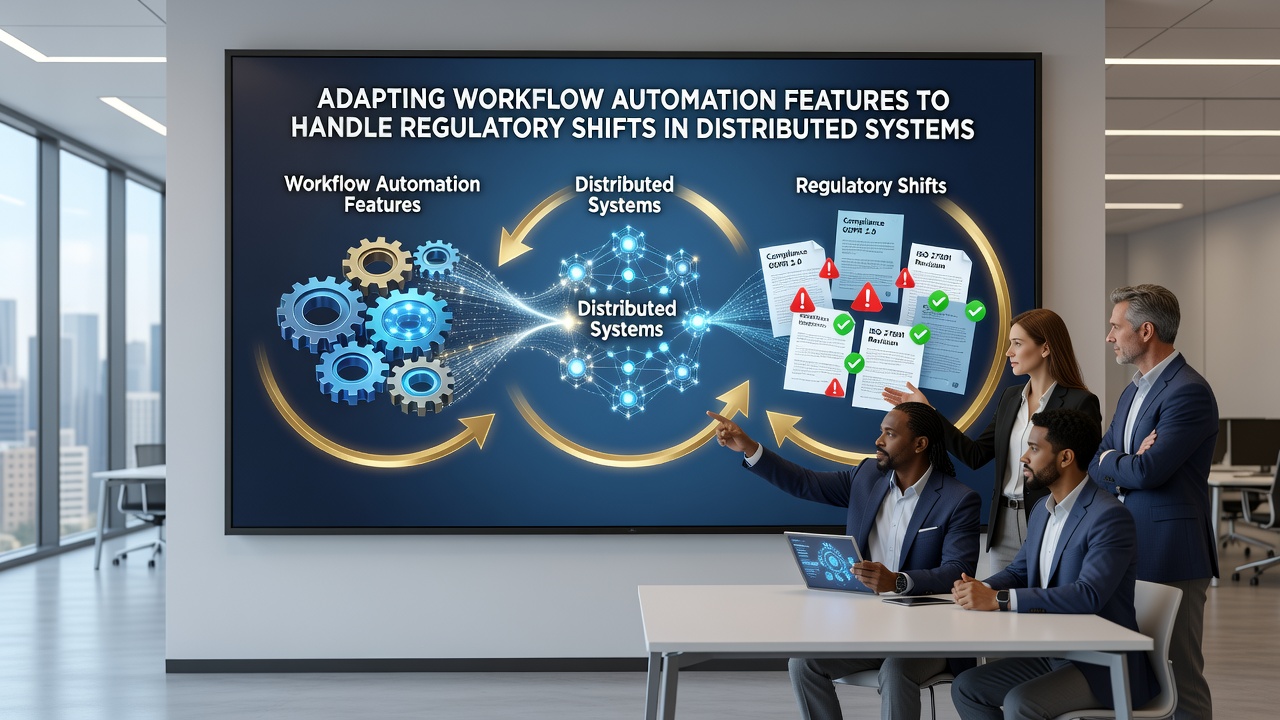
Distributed systems have grown more complex as organizations rely on multi-cloud setups, edge computing nodes, and containerized microservices to manage operations at scale, and regulatory requirements continue to evolve in parallel with these architectures. Workflow automation features must incorporate dynamic compliance checks that respond to new rules without disrupting service continuity across geographically dispersed components.
Regulatory Changes Affecting Distributed Environments
Multiple jurisdictions have introduced or updated data handling mandates that directly impact how information flows through automated pipelines. Research from the Office of the Privacy Commissioner of Canada indicates that amendments to personal information protection rules now require explicit consent mechanisms at each processing stage in distributed networks, while similar updates in other regions emphasize data residency constraints. These shifts create pressure points where legacy automation scripts fail to reroute tasks or apply encryption standards on the fly.
October 2026 marks the scheduled implementation date for several updated frameworks governing cross-border data transfers in cloud environments, which means teams managing distributed systems need automation layers capable of detecting jurisdiction-specific triggers and enforcing them in real time. Observers note that organizations with rigid workflow engines often experience processing delays when new localization rules activate, whereas those with modular rule engines can swap compliance modules without halting operations.
Key Challenges in Current Automation Setups
One recurring issue arises when automation tools lack visibility into the full topology of a distributed system, so they cannot adjust parameters such as data retention periods or audit logging frequencies when regulations change. Studies from the National Institute of Standards and Technology have shown that systems relying on static scripts encounter compliance gaps during sudden policy updates because the scripts do not query live regulatory databases or integrate with external compliance services.
Another challenge surfaces in environments that span multiple regulatory zones simultaneously, where an automated workflow might route sensitive records through a node that suddenly falls under stricter oversight. Those who have examined production incidents report that latency spikes occur when automation must pause, query external rule sets, and resume, highlighting the need for pre-cached decision trees that update through secure feeds.
Techniques for Updating Automation Features
Engineers address these issues by embedding policy-as-code modules into workflow orchestration platforms, allowing rules to be versioned and deployed alongside application code. This approach lets teams test regulatory adaptations in isolated sandboxes before pushing changes to live distributed clusters. Data indicates that such modular designs reduce the time required to align workflows with new mandates from weeks to hours in many documented cases.
Additional adaptations include integrating event-driven listeners that monitor regulatory announcement channels and trigger reconfiguration scripts across nodes. In practice, these listeners connect to official government portals and industry registries, then propagate updates through message queues so that every microservice receives consistent instructions without manual intervention. Researchers have documented successful implementations in financial services platforms where transaction routing logic adjusts automatically when new reporting thresholds take effect.
Implementation Patterns Observed in Practice
Teams often start by mapping every workflow step to the specific regulatory articles it touches, then build conditional branches that activate only when certain conditions are met. This mapping exercise reveals hidden dependencies, such as logging services that must increase verbosity levels to satisfy audit requirements in particular regions. Once identified, these branches can be automated through configuration files that pull the latest rule interpretations from trusted sources.
Another pattern involves deploying sidecar containers alongside primary services to handle compliance logic separately, which keeps core automation code lean while allowing independent updates to the regulatory layer. Observers have recorded that this separation improves maintainability, especially when multiple teams own different parts of a distributed architecture and must coordinate on compliance changes.
Monitoring and Validation Approaches
Continuous validation forms a critical component of any adaptation strategy, with automated test suites simulating regulatory scenarios across simulated node failures and network partitions. Metrics collected during these tests help identify bottlenecks where regulatory checks add unacceptable overhead, prompting optimizations such as caching frequently used rule evaluations or batching compliance reports. Evidence from enterprise deployments shows measurable improvements in both compliance accuracy and overall throughput once these monitoring loops mature.
Conclusion
Adapting workflow automation to regulatory shifts in distributed systems requires modular designs, real-time policy integration, and rigorous validation practices that keep pace with evolving mandates. Organizations that implement these capabilities maintain operational continuity while meeting obligations across jurisdictions, and the patterns described here continue to inform ongoing development in the field.